Termite pressures in Charleston County remain severe due to the subtropical climate, coastal water tables, and extended warm seasons that allow subterranean colonies to feed uninterrupted year-round. Native…
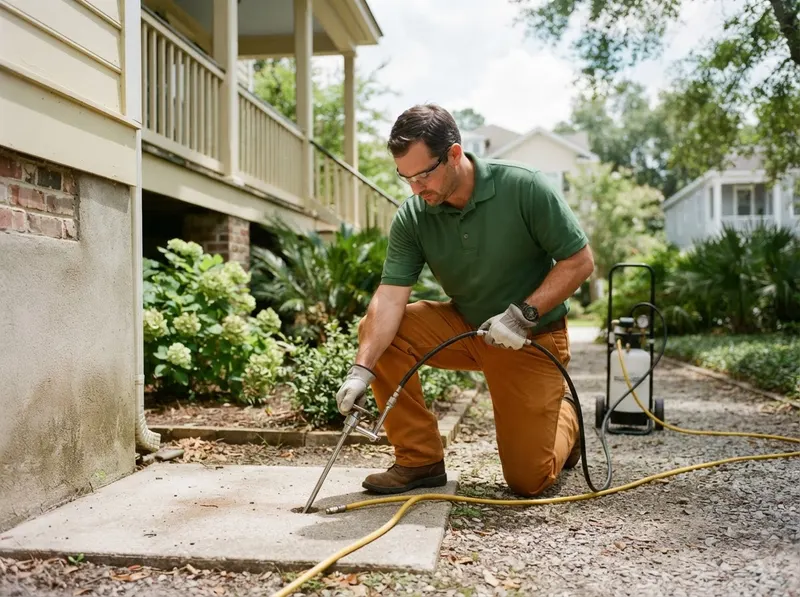
Termite pressures in Charleston County remain severe due to the subtropical climate, coastal water tables, and extended warm seasons that allow subterranean colonies to feed uninterrupted year-round. Native subterranean termites nest in damp subterranean soil, entering structures through microscopic foundation fissures. Formosan termites, an introduced subterranean species prevalent throughout coastal South Carolina, establish supercolonies containing millions of individuals that construct secondary aerial cartons inside wall cavities without requiring constant ground contact. According to structural guidelines documented by the Clemson University Cooperative Extension, Formosan colonies cause structural damage at rates multiple times faster than native species, making early identification essential in historic wood-frame architecture.
Treatment protocol relies on continuous chemical barriers or slow-acting colony elimination baits. The United States Environmental Protection Agency details that non-repellent liquid termiticides, such as fipronil, transfer undetectable active agents among foraging workers through grooming behaviors to eradicate the subterranean queen. Non-repellent perimeter trenching fits crawlspace and pier foundations common in South of Broad, Harleston Village, and Radcliffeborough, where sandy loam allows uniform saturation down to footer depths. In modern slab-on-grade construction across Daniel Island, Cainhoy Peninsula, and West Ashley, specialized baiting stations, conforming to industry testing from the Pest Control Technology trade technical standards, intercept subterranean foragers along the landscape perimeter before they bridge expansion joints or plumbing penetrations.
Subterranean termite management differs significantly from drywood termite protocols. Drywood species live exclusively inside seasoned timber and require structural gas fumigation or localized wood injection. In contrast, subterranean and Formosan species travel through subterranean mud exploration tubes and require complete soil-barrier displacement or continuous bait suppression. Choosing continuous perimeter trenching requires digging a 6-inch-wide by 6-inch-deep trench around all ground contact points, applying termiticide at a calibrated rate of 4 gallons per 10 linear feet per foot of depth, as established under USDA Forest Service wood durability research. While liquid soil treatments deliver immediate mortality barriers, exterior bait stations offer a less invasive approach for properties bordered by finished hardscapes, historical brick pavers, or strict ground disturbance limitations near The Battery and White Point Garden.
Long-term moisture control serves as the primary preventative defense against recurring subterranean activity. High relative humidity and standing crawlspace water provide the moisture reserves subterranean species require to survive above the groundline. Standards maintained by the EPA Indoor Environments Division recommend keeping structural wood moisture content below 19% to suppress both wood-decay fungi and subterranean insect colonization. Installing 10-mil polyethylene vapor retarders across exposed crawlspace dirt in James Island and Wagener Terrace reduces ground evaporation, directly limiting the conditions Formosan termites exploit to construct aerial carton nests. Property managers can schedule an on-site structural evaluation by phoning (843) 268-6980.
Every job gets a firm, written price after a free on-site visit.
Tell us about your subterranean and formosan termite control job in Charleston and we'll send a clear, written quote, usually the same day.
 FalconVale Insect Services