FalconVale Insect ServicesFalconVale Insect Services

Crawl Space Encapsulation and Pest Exclusion Charleston

Beneath raised foundations in coastal South Carolina, open crawl spaces operate as damp chimneys that pull tidal moisture and soil pests directly into subflooring. Homes near marsh borders in James Island, West Ashley,…
Get My Free Estimate →(843) 268-6980
Crawl Space Encapsulation and Pest Exclusion in Charleston, SC
Quick answer
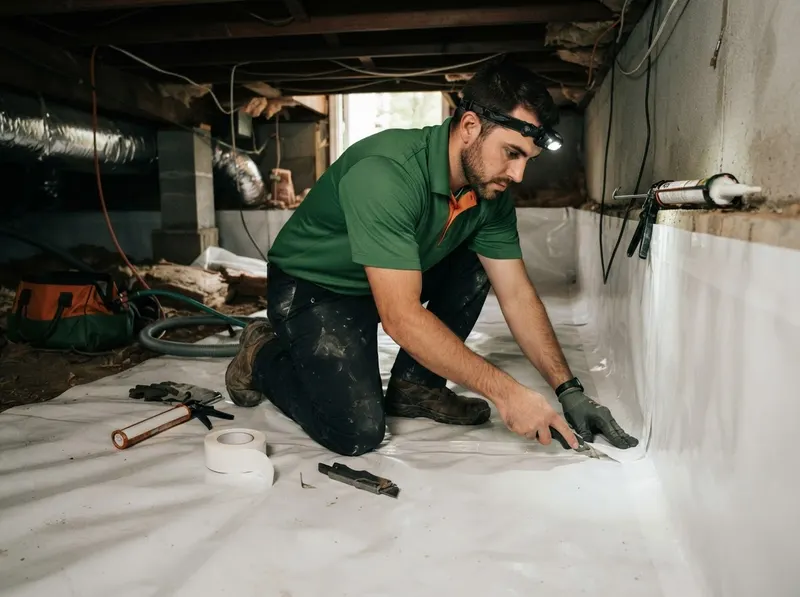
  • What is included: 12-mil to 20-mil reinforced floor and wall vapor barrier liners, masonry vent seals, wire mesh weep-hole covers, commercial crawl space dehumidifier installation, and structural penetration foam sealing.
  • Turnaround time: Most residential encapsulations take 2 to 4 business days to complete, following an initial 60-minute subterranean moisture evaluation.
  • Service cost: Total investment ranges between $3,500 and $12,500 based on square footage and moisture load; single-point entry seal jobs start at our standard $200 service minimum.
  • Pests and issues managed: Subterranean termites, smokybrown roaches (palmetto bugs), moisture ants, camel crickets, silverfish, rodent runs, and wood-decay fungus.
  • Booking protocol: Property evaluations can be scheduled directly by telephone at (843) 268-6980; on-site diagnostic technicians verify precise dimensions before finalizing estimates.

Beneath raised foundations in coastal South Carolina, open crawl spaces operate as damp chimneys that pull tidal moisture and soil pests directly into subflooring. Homes near marsh borders in James Island, West Ashley, and the Cainhoy Peninsula frequently record crawl space relative humidity above 75%, providing ideal harborage for eastern subterranean termites and opportunistic rodents. Standard atmospheric venting, originally designed to air out structures, draws warm, humid Atlantic air across cool floor joists, causing rapid condensation. Ground contact barriers paired with heavy-duty crawl space sealants physically sever this environmental bridge, ensuring that structural timbers dry below the critical 15% wood moisture threshold required to inhibit wood-destroying fungal rot, as detailed in research by the Clemson University Cooperative Extension Service.

Historic downtown residences in South of Broad, Harleston Village, and Radcliffeborough feature antique heart-pine timbers resting on unreinforced brick piers that are uniquely susceptible to dampwood pests and smokybrown cockroaches, commonly known as palmetto bugs. In historic restorations, sealing the ground plane with high-puncture 20-mil polyolefin barriers adheres to moisture control frameworks recognized by the U.S. Department of Energy, while maintaining structural masonry breathability. Mechanically sealing foundation vents and exterior band sills cuts off the subterranean highway that insect colonies use to access kitchen walls and living areas. For neighborhoods with higher water tables like Wagener Terrace or low-elevation marsh borders along Daniel Island, interior trenching and dedicated sump systems evacuate pooled water before closed-cell spray barriers are anchored.

Every structural intervention requires strict adherence to building code standards. According to the International Code Council IRC Section R408.3, unvented crawl spaces must incorporate a continuous mechanical drying mechanism and leave a visible 3-inch inspection gap along termite shields. Installing an ENERGY STAR certified moisture removal system, rated according to the U.S. Environmental Protection Agency Indoor airPLUS specifications, maintains ambient under-home humidity below 55%. Field technicians also verify that combustion appliances receive adequate makeup air per standards established by the National Fire Protection Association, avoiding backdrafting hazards when closing off exterior foundation vents. This mechanical stabilization permanently resolves heavy invertebrate infestations without recurring pesticide inundation inside living quarters.

How much does Crawl Space Encapsulation and Pest Exclusion cost in Charleston?

Targeted Entry-Point Pest Exclusion Only$200 - $650
Standard Vapor Barrier Replacement (up to 1,500 sq ft)$1,200 - $2,800
Full Encapsulation with Sump Basin (1,500 - 2,500 sq ft)$5,500 - $9,500
Historic Brick Pier Deep Encapsulation with Dehumidifier$8,500 - $14,000

Every job gets a firm, written price after a free on-site visit.

Common questions

Why does a home in Charleston SC need encapsulation instead of open vents?
Coastal ambient humidity in Charleston regularly exceeds 80%, meaning open foundation vents introduce saturated air that condenses on subflooring rather than drying it out. Encapsulation seals the substructure to lock out damp marsh air, reducing wood moisture levels below the threshold where termites, mold, and wood-boring beetles can thrive.
How does pest exclusion work during the encapsulation process in Charleston?
Pest exclusion seals every structural entry point beneath the house using galvanized steel mesh, copper mesh, and pest-rated expanding foam along foundation penetrations, sill plates, and masonry joints. This barrier stops rodents, palmetto bugs, and subterranean insects from moving out of soil zones and directly into Charleston living spaces.
Does Charleston building code require a termite inspection band on encapsulated crawl spaces?
South Carolina residential building regulations mandate an uninterrupted 3-inch bare wood inspection gap between the top of the vapor barrier wall liner and the wooden sill plate. This visible boundary ensures licensed inspectors can detect mud shelter tubes built by subterranean termites attempting to bypass the barrier.
What is the minimum cost for crawl space services in Charleston SC?
Crawl space evaluations and isolated pest-entry exclusion work start at our $200 minimum fee. Comprehensive multi-step cleanouts, full-ground multi-ply liner installations, and high-capacity dehumidifier additions scale upward based on measured foundation square footage and clearance heights.
Can encapsulation eliminate existing mold and palmetto bugs under a Charleston house?
Physical encapsulation starves existing insect colonies and fungal spores by removing the ambient humidity and surface condensation they require to survive. Once the sealed space stabilizes below 55% relative humidity via dedicated dehumidification, moisture-dependent pests migrate away or perish entirely.

Get started today

Tell us about your crawl space encapsulation and pest exclusion job in Charleston and we'll send a clear, written quote, usually the same day.

Get your free Pest Control Service quote, Charleston

We only use your ZIP to check availability, no spam.