Coastal salt marshes create relentless breeding habitats where standard suburban sprays fail against microscopic biting midges, known locally as no-see-ums. According to the US EPA mosquito control guidelines ,…
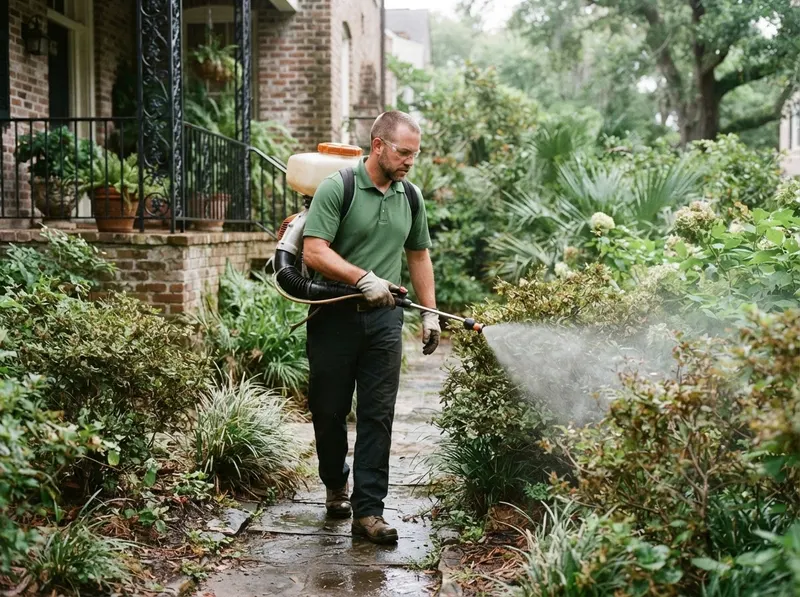
Coastal salt marshes create relentless breeding habitats where standard suburban sprays fail against microscopic biting midges, known locally as no-see-ums. According to the US EPA mosquito control guidelines, effective community relief requires pairing adulticides with targeted juvenile growth regulators. Properties along the Cainhoy Peninsula and Daniel Island sit adjacent to tidal estuaries where Culicoides furens larvae mature in intertidal mud. A protective perimeter requires micro-encapsulated barrier sprays applied along the underside of broadleaf plants, palmettos, and ornamental shrubs. Data from the Centers for Disease Control mosquito prevention protocols confirms that treating vegetation resting areas dramatically drops biting counts. In dense neighborhoods like Harleston Village and Radcliffeborough, historic courtyards trap ambient humidity against brick boundary walls. FalconVale Insect Services treats these micro-climates using ultra-low-volume droplet distribution to penetrate private garden enclosures without damaging pollinator flight pathways. Homeowners can reach our dispatch at (843) 268-6980 for property evaluations.
Water management forms the foundation of sustainable perimeter sanctuary. Research from the Clemson University Cooperative Extension Service shows that female mosquitoes lay up to 200 eggs at a time in containers holding as little as an ounce of stagnant liquid. Properties across West Ashley and James Island often experience pooling water near foundation drip lines and retention ditches. Technicians place granular biological treatments containing Bacillus thuringiensis israelensis (BTI) into non-potable water, killing feeding larvae within 24 hours without harming birds or domestic pets. Guidelines maintained by the South Carolina Department of Health and Environmental Control highlight how vector suppression limits public health exposure to insect-borne pathogens. In addition, the Entomological Society of America certification standards underline the necessity of applying barrier films specifically during low-wind windows to eliminate off-target drift. For properties bordering river systems, such as marsh-front parcels in Wagener Terrace near the Ashley River, specialized wind-rated droplet emitters ensure compounds adhere directly to foliage surfaces.
Historic downtown structures face unique challenges where brick moisture retention fosters shaded insect harborage. South of Broad residences with brick piazzas and sub-grade crawl spaces require targeted misting beneath wooden decking and along foundational stone. Technical publications from the National Pest Management Association confirm that biting gnats pass through standard 16-mesh window screening, making direct outer perimeter suppression essential for interior comfort. FalconVale Insect Services complies with all regulatory spray restrictions established by the Clemson Department of Pesticide Regulation, maintaining strict setbacks from open water bodies and public streets. In accordance with the U.S. Fish and Wildlife Service coastal habitat preservation rules, treatments along private marsh edges never introduce active ingredients into tidal marsh water. If an active infestation spreads from neighboring unmanaged vegetation, high-frequency treatments every 21 days hold biting insect activity down, whereas seasonal three-application programs fit inland, low-canopy lots. When questions arise regarding marshland boundaries or site evaluations, scheduling through (843) 268-6980 allows technicians to plan appropriate mechanical barriers.
Every job gets a firm, written price after a free on-site visit.
Tell us about your lowcountry mosquito and no-see-um suppression job in Charleston and we'll send a clear, written quote, usually the same day.
 FalconVale Insect Services